









Electronics Development | Automotive
Software Virtualization: Virtual Protection of Hardware and Software in the Entire Vehicle
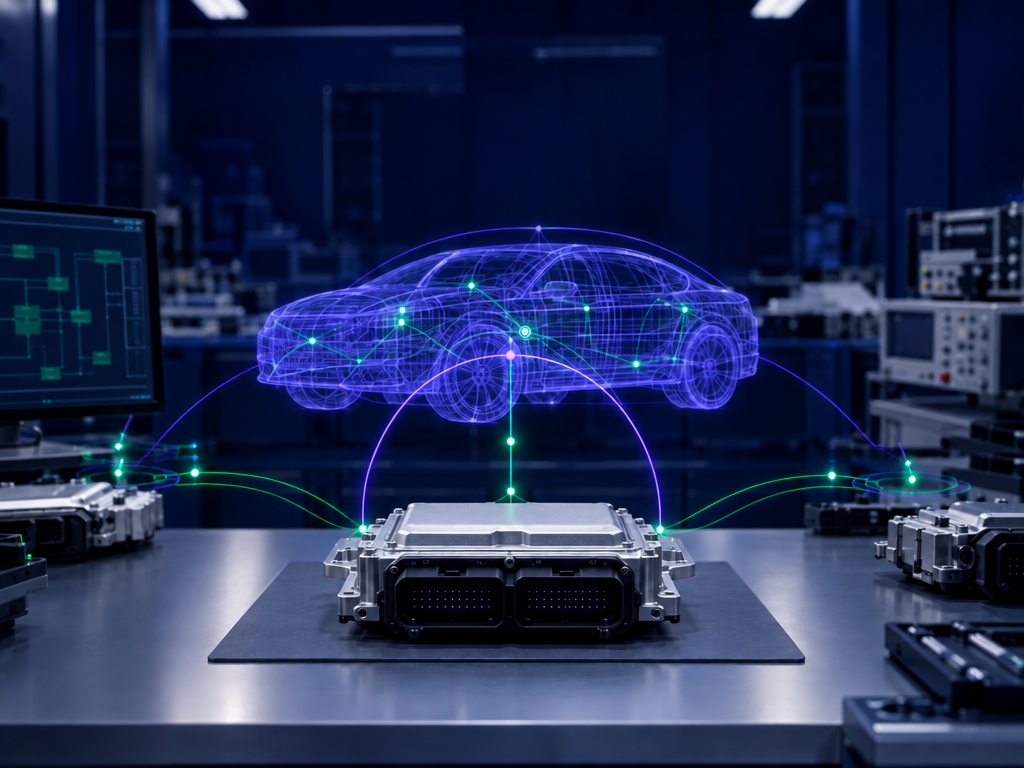
The increasing number of interfaces per control unit is making the functional chains in vehicles more complex. As a result, customer functions can now only be effectively validated at the whole-vehicle level. A global automaker therefore needed to develop a software virtualization strategy to integrate and validate E/E hardware and software. By using software virtualization, the company aimed to enable fast development cycles and scalable validation instances. This required a virtual complete vehicle. Together with KBC, the company developed a management recommendation for the strategic implementation of virtual validation in the complete vehicle, including the technical specifications for the control units.
Software Virtualization by the Numbers
The Customer
A leading automaker
The customer is a global automotive manufacturer. Due to the steadily growing number of interfaces per control unit, its vehicles feature increasingly complex chains of effects. This development demonstrated that, going forward, customer functions can only be effectively validated at the level of the entire vehicle—no longer in isolation at the level of individual control units or domains. At the same time, the customer wanted to enable rapid development cycles in line with continuous delivery, integration, and testing, and to provide scalable validation environments. To achieve this, the customer needed a clear strategy for software virtualization and a sound basis for decision-making regarding the implementation of a virtual complete vehicle. This strategy also needed to take into account technical requirements for future generations of control units over a long-term time horizon spanning several years.
The Project
Software Virtualization for the Integration and Validation of E/E Hardware and Software
At the outset, the project team, together with those responsible for control units in the various departments and domains, documented the current activities and strategic directions regarding software virtualization. To this end, the team conducted interviews. Subsequently, in collaboration with the relevant departments in E/E validation, the team identified future integration and validation requirements for a time horizon of more than nine years. KBC identified and evaluated technical solutions for the virtualization of control units. Building on this, the team developed scenarios for the individual domains and for the vehicle as a whole. It assessed the scenarios in terms of their risks for future integration and validation. This created a well-founded and transparent basis for the strategic decision—rather than relying on individual, isolated solutions for each domain and identifying risks only late in the project.


The result
Well-Informed Management Decision on Software Virtualization for the Entire Vehicle
At the end of the project, the team, in collaboration with the validation departments, identified and evaluated the objectives for integration and validation at the domain and full-vehicle levels. The time frame spanned over nine years. Based on this, the project team derived and coordinated specific technical requirements for the control units. These requirements were necessary for the implementation of the developed virtualization scenarios. In addition, KBC prepared the management decision to define the requirements for software virtualization in the ECU specifications and supported the decision-making process through to the final implementation decision. This provides the customer with a robust, long-term foundation for efficiently integrating and validating its entire vehicle virtually in the future. As a result, the customer will not have to start from scratch with each new generation of ECUs.