









Data & AI | Automotive | After-Sales
AI in Service: Intelligent Support for Workshop Employees at a Leading Commercial Vehicle Manufacturer
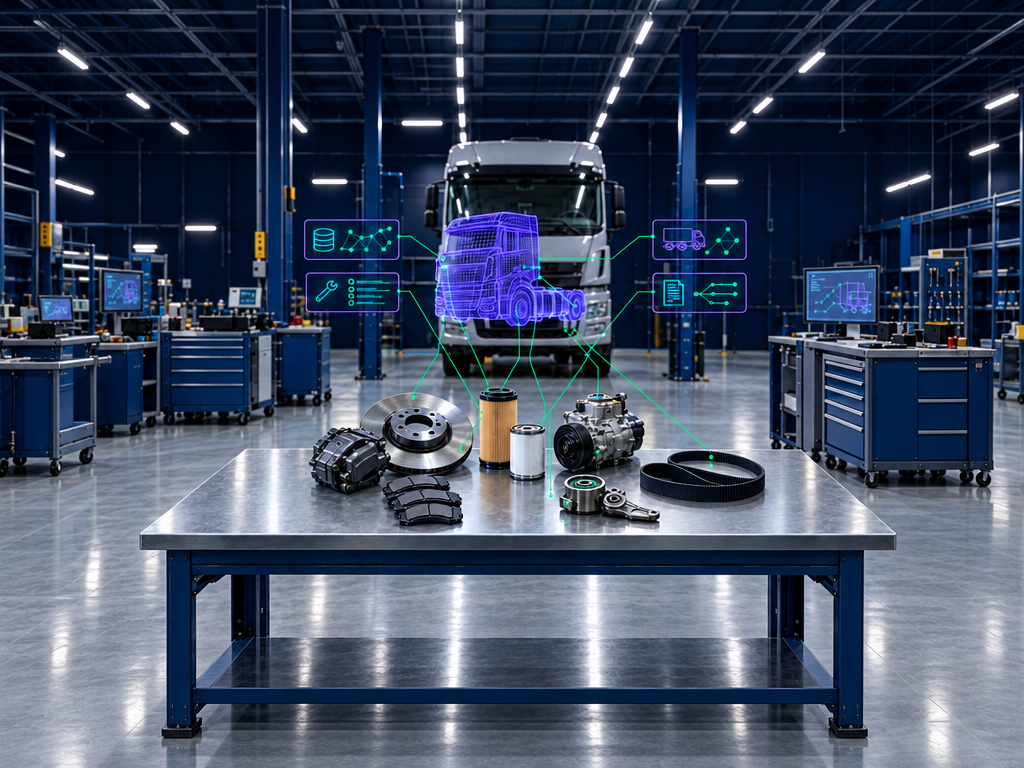
A leading international commercial vehicle manufacturer wanted to significantly reduce the workload for its service shop employees when creating repair orders. To that end, as part of a program to transform service order processing, the company developed an AI-powered application for service shop orders. The use of AI in service is intended to automatically provide service shop employees with appropriate suggestions for replacement parts and work steps.
The Customer
A leading commercial vehicle manufacturer
The customer is an international manufacturer of commercial vehicles with an extensive service network. Until now, workshop orders were created through a series of manual steps in SAP. This process was inefficient for workshop staff: The many manual steps were time-consuming and prone to errors, which could negatively impact the quality of customer service.
Because digital and intelligent service processes were becoming increasingly important for competitiveness, the customer wanted to fundamentally modernize its service processes. The goal was to significantly improve speed, quality, and efficiency throughout the entire process and to use AI to specifically reduce the workload of workshop employees.
In particular, searching for the right replacement parts and work steps in SAP required numerous individual entries and clicks. This is where AI should come into play in service operations to simplify the creation of workshop orders.
The Project
AI in Customer Service for Automated Repair Recommendations
The goal was to analyze the creation of shop orders and reduce the manual effort involved in service operations through the use of AI. A machine-learning system uses historical shop orders, parts master data, and general vehicle information to suggest appropriate replacement parts and work steps. Shop employees can incorporate these AI suggestions into the shop order as needed. Implementation began with a proof of concept, which the project team successfully completed, thereby confirming the feasibility of the approach. Building on this, the team developed the model in a cloud environment during the build phase, expanded the existing SAP functionality, and conducted user acceptance testing.
The build phase was followed by a structured quality assurance process, during which the department validated the AI suggestions through large-scale testing and random sampling. The workshops were regularly involved to gather feedback from experienced technicians on the suggestions and their applicability in day-to-day workshop operations. Each phase provided concrete insights for the next steps and helped to continuously improve the quality of the AI suggestions. This ensures that AI remains transparent and accountable in the service process: The system supports workshop employees in their decision-making but does not replace them.


The result
AI in Customer Service for Faster Order Processing
The model we’ve developed and the expanded system functionality lay the technical foundation for AI-powered repair recommendations. The expected benefit lies primarily in faster creation of repair orders: Instead of searching for each repair order item individually in SAP and navigating through multiple data entry steps, employees will automatically receive suggestions for appropriate replacement parts and work steps. This can save numerous clicks and reduce the manual effort involved in creating orders. As a result, workshop employees will have more time to spend with their customers. The suggestions can also help ensure that workshop orders are prepared more thoroughly.