










article
Autonomous Driving: Here's the Real State of the (Automotive) Industry
“Driverless cars will be here in just five years”[1]—that was the headline of a 2015 article in the newspaper WELT, and it was just one of many that predicted the advent of autonomous driving for the early 2020s. In 2017, the German federal government passed theAutomated Driving Act.This was followed in July 2021by the Autonomous Driving Act, which generally permits the operation of autonomous vehicles on public roads nationwide.[2]Apart from a few pilot projects, however, autonomous driving is still far from being a part of everyday life today. The reasons for this are manifold, and the entire endeavor faces immense challenges.
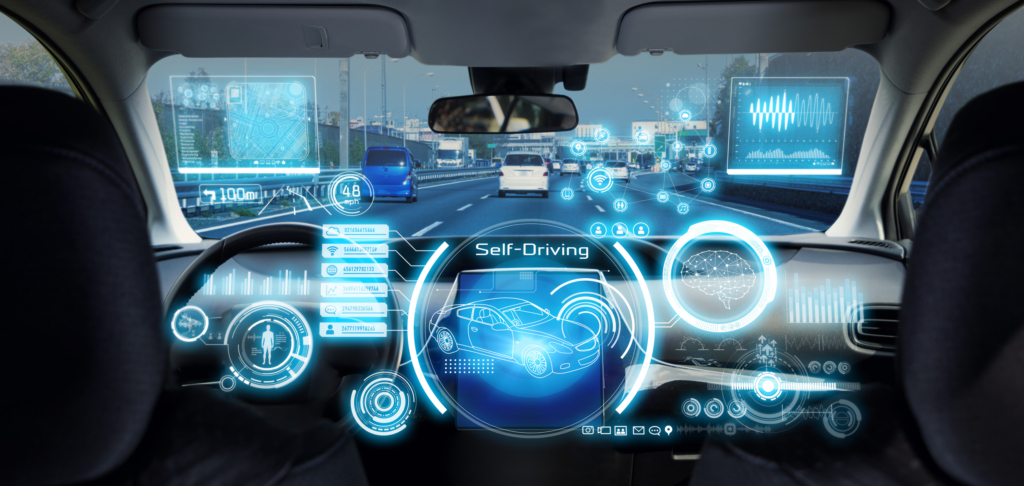
Autonomous Driving: The whole world is talking about it, but what exactly does it mean?
What will the mobility of tomorrow look like? In scenarios exploring this question, autonomous driving is already a central component intended to make everyday traffic safer and more efficient. However, this does not always refer to fully autonomous vehicles that take passengers to their destination. Even partial vehicle automation could provide significant added value in terms of safety and efficiency in road traffic. To classify autonomous driving capabilities, the Society of Automotive Engineers (SAE) International has defined a total of six automation levels in the SAE J3016 standard. The publication of this standard established a uniform industry-wide understanding of the various levels.[3]A key criterion in the standard for differentiating between the levels is the role of the driver during the trip.
The Six Levels of Automation Leading to Autonomous Driving
Below, we outline Levels 0 through 5 based on their features and autonomous capabilities.

Automation Levels 0–1
Level 0 vehicles are not equipped with driver-assistance features. A vehicle with integrated driver-assistance systems that are used independently, on the other hand, falls under Level 1, or assisted driving. Examples of integrated driver-assistance systems used independently include adaptive cruise control and lane-keeping assist.
Automation Level 2
Level 2, or semi-automated driving, combines individual driver-assistance systems. This allows certain driving tasks and maneuvers to be performed without driver intervention. This level is achieved byTesla Autopilot®, although the name of this feature suggests a supposedly higher level. Tesla combines adaptive cruise control with lane-keeping assist in its vehicles and, according to the standard, thus actually only enables assisted driving. For the first three levels, once the assistance systems are activated, the driver is merely assisted, as described. It is therefore possible to temporarily take one’s hands off the steering wheel; however, the driver must monitor the system’s operation and be able to regain control of the vehicle at any time.
Automation Level 3
The distinguishing feature compared to Level 3 and beyond is that, in certain traffic situations, the task of driving is performed not by the driver but by driver assistance systems. The driver can therefore temporarily take their attention off the task of driving.[4]This is made possible, for example, by theDrive Pilot®in the 2021 Mercedes-Benz S-Class. It takes over control of the vehicle in heavy traffic or traffic jams at speeds of up to 60 km/h. Level 3 operation of a vehicle therefore only allows for automated driving under these specific conditions, such as driving on highways in heavy traffic at speeds up to 60 km/h.
Automation Level 4
Level 4 operation of a vehicle differs from Level 3 in that control of the vehicle no longer needs to be transferred to the driver. However, this is only possible under certain conditions. Level 4 is associated with so-called robotaxis, such as those currently offered by Google subsidiary Waymo LLC in Phoenix and San Francisco. The suburbs of Phoenix, where the robotaxi is in operation, offer a very predictable climate, good road conditions, and consistent traffic patterns.
Automation Level 5
The highest level is reached when vehicles can drive on their own—regardless of traffic conditions and geographical limitations, and without requiring any intervention from the driver. In this context, we refer to Level 5 vehicles and autonomous driving. However, Level 5 is currently still a theoretical ideal. In actual development, priority is currently being given to Level 3 and 4 vehicles.
The Automotive Industry and Its Non-Automotive Competitors: The Current State of Affairs
The implementation of automated and autonomous driving requires complex interaction between various driver assistance systems (DAS) and high-performance computing units for data processing. Consequently, complexity is increasing due to the integration of high-resolution sensor systems, while data processing demands are also high. This interplay is increasingly attracting companies from outside the automotive industry to enter the market. These include tech and mobility companies such as Google subsidiary Waymo, semiconductor giant Intel, and graphics processor specialist Nvidia. All of these companies have already become major players in autonomous driving. According to reports, Apple is also considering entering the market with its own vehicle.[5]
At the same time, established and renowned companies in the automotive industry are increasingly recognizing that fully automated or autonomous driving is beyond their capabilities. As a result, both manufacturers and suppliers are seeking to join forces with tech companies and mobility service providers. For example, Volkswagen AG is collaborating with Argo AI LLC, a company specializing in autonomous driving, to develop the self-driving taxi shuttle VW.ID BUZZ AD (Autonomous Driving). Daimler AG is working with Nvidia toequip its own driver-assistance systems with the U.S. company’s technology.[2]The first deployment is planned for 2024 as part of a new vehicle architecture.[6]
At this year’s IAA Mobility in Munich, two companies outside the automotive industry—the car rental company Sixt, in collaboration with Intel subsidiary Mobileye—announced that they would launch a self-driving taxi service as early as 2022. Our illustration provides further examples of current partnerships and advancements in the field of automated and autonomous driving.

Key Challenges in the Field of Automated and Autonomous Driving
Technological Complexity
A key challenge of automated or autonomous driving is the technological complexity and maturity of the vehicles and their integrated systems. The driver assistance systems used in the vehicle must ensure flawless detection of the surroundings and objects at all times, as well as the correct interpretation of every traffic situation, regardless of weather conditions. To this end, proven systems such as lane-keeping assist are networked with one another and supplemented by the latest generation of highly complex sensor systems for detecting the vehicle’s surroundings. The intelligent combination of camera, radar, and LiDAR sensors provides a comprehensive 360° view around the vehicle. The use of these systems necessitates high computing power, combined with the use of artificial intelligence, to process the vast amounts of data generated while driving.
At the same time, the proportion of software and electrical/electronic components in vehicles is increasing. Signals and data from driver-assistance systems must be processed, and the powertrain, steering, and braking systems must be controlled accordingly. Managing this system complexity poses enormous challenges for the entire industry.
From a technological standpoint, automated or autonomous driving is still in its infancy. In addition to technological maturity, other challenges include establishing a globally uniform regulatory framework and gaining public acceptance of autonomous driving. Although Germany became the first country in the world in July 2021 to enact a law permitting autonomous operation on public roads in certain use cases, However, according to the law, a driver must be ready to take over at any time. This principle has been required since the 1968Vienna Convention on Road Traffic.[7]The scenario in which all vehicle occupants are passengers and there is no driver in the vehicle has not yet been specified internationally.
Legal Uncertainties
Furthermore, there is a need to harmonize existing national legal frameworks worldwide. Currently, different regulations exist in EU member states and individual U.S. states. The German law on autonomous driving is therefore considered a transitional solution until internationally harmonized regulations are in place. For Renata Jungo Brüngger, a member of the Board of Management of Daimler AG responsible for Integrity and Legal Affairs, legal certainty is the key step that will increase acceptance of automated and autonomous driving.[8]This is because public opinion and trust continue to be undermined by accidents caused, for example, by faulty object detection.
At the same time, the industry is repeatedly confronted with ethical questions in the event of an accident. In certain situations, an automated vehicle may perform an evasive maneuver to prevent a collision. However, this may put other uninvolved road users at risk. The definition of such an evasive maneuver is, however, ethically controversial. The behavior of an autonomous vehicle in the event of an accident—and the resulting damage, including to (uninvolved) individuals—is something that must be determined as early as the development phase of driver-assistance systems.
The road to autonomous driving in everyday life is—and will remain—a long one
Fully automated driving still has a long way to go before it becomes part of everyday life. As a result, for many people, their first ride in a fully automated or autonomous vehicle will likely be through a mobility service. The high cost of the necessary driver-assistance systems initially limits automated driving in private passenger cars to a small number of luxury vehicles. Mass-market vehicles will not be equipped with such features in the short to medium term. Furthermore, a shift in public awareness toward the sharing economy is currently emerging. Ownership of a private vehicle (or other consumer goods) is losing its significance.[9]
However, the demand for flexible mobility services, such as ride-hailing, is on the rise. [10]This eliminates the general fixed costs of vehicle ownership as well as obligations such as repairs or tire changes. This trend is supported by increased environmental awareness among the public[10]. Therefore, it is highly likely that fully automated or autonomous driving will initially only be available through public mobility services. These services will in all likelihood still be available by 2025. However, it will take many more years before autonomous vehicles account for a significant share of road traffic. Until then, we can only wait and see what progress the (automotive) industry makes and how it addresses the challenges it faces.
Sources
[1]Die WELT – Driverless cars will be here in five years
[2]Federal Ministry of Transport and Digital Infrastructure (BMVI) – Autonomous Driving Act
[3]SAE J3016 Standard for Autonomous Driving
[5]Apple Car Production by 2024
[6]Daimler is partnering with Nvidia
[8]Daimler: Harmonize the Legal Framework